Many people first experience AI through chat. They ask a question, receive an answer, refine the prompt, and use the output. This is a powerful starting point. AI chat tools can help with writing, summarizing, planning, learning, brainstorming, and research.
But the AI landscape is moving beyond single-response chat. The next stage is about systems that can coordinate multi-step work, use tools, retrieve information, remember context, follow workflows, and support increasingly autonomous task execution. This is where agentic AI enters the conversation.
Agentic AI does not replace basic AI skills. It builds on them. Before organizations can use agentic systems well, they need to understand prompting, tool fit, productivity, research, knowledge grounding, workflow design, governance, and human oversight. In other words, agentic AI comes after basic AI tools, not before them.
From Chatbot to Copilot to Agent
A simple maturity path is:
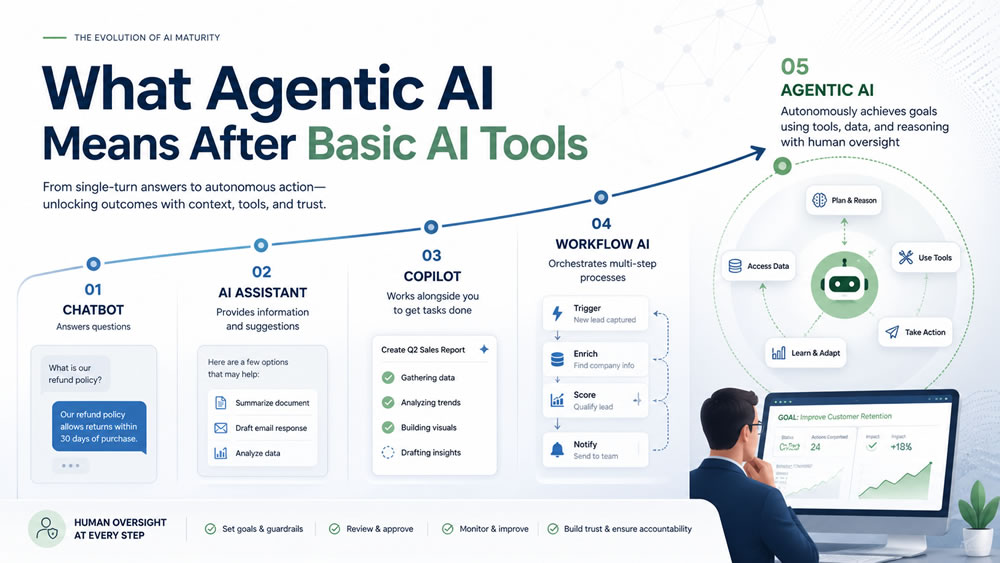
Chatbot → Assistant → Copilot → Workflow AI → Agentic AI
A chatbot responds to questions. It may answer, draft, summarize, or explain.
An assistant supports a wider range of tasks and may work with files, images, voice, or structured formats.
A copilot is often embedded in a work environment, such as Microsoft 365 or Google Workspace. It helps inside documents, emails, meetings, spreadsheets, and presentations.
Workflow AI supports process steps, such as routing, classification, extraction, approval support, and task handoffs.
Agentic AI coordinates multi-step work toward a goal. It may plan, retrieve information, use tools, call APIs, revise outputs, and escalate exceptions.
This progression helps clarify what makes agentic AI different. It is not just a more powerful chatbot. It is a system designed to perform coordinated work.
What Makes an AI System Agentic?
An agentic AI system usually has several characteristics.
First, it has a goal or task objective. Instead of answering one isolated question, it works toward completing a task.
Second, it can plan steps. It may break a task into smaller actions.
Third, it can use tools. It may search documents, query a database, call an API, update a record, send a notification, or trigger a workflow.
Fourth, it can use context. It may retrieve information from documents, data systems, previous interactions, or memory.
Fifth, it can revise. It may evaluate its output, adjust its approach, or ask for human input.
Sixth, it may operate with some level of autonomy, though responsible systems should define clear boundaries and review points.
These capabilities create business value, but they also increase governance needs.
Why Basic AI Skills Still Matter
Some organizations want to jump directly to agents. That can be risky.
Agentic AI depends on the foundations built through basic AI adoption. If users do not understand prompting, they will struggle to define agent tasks. If documents are messy, agents may retrieve weak information. If workflows are unclear, agents may automate the wrong process. If governance is immature, agents may act beyond appropriate boundaries. Basic AI skills are not optional. They are prerequisites.
Organizations should build capability in stages:
- AI literacy and prompting
- Personal and workplace productivity
- Tool fit and responsible use
- Source-grounded knowledge work
- Workflow mapping and automation
- Agentic AI design and governance
This sequence is practical because it develops both user skill and organizational maturity.
Business Examples of Agentic AI
Agentic AI becomes useful when work involves multiple steps, multiple sources, and repeatable decisions.
Customer Support Triage
An agentic workflow may read an incoming customer request, classify the issue, retrieve relevant policy guidance, draft a response, create a support ticket, route it to the right team, and escalate high-risk cases. This is different from a chatbot simply answering a customer question. It coordinates work across steps.
Sales Research and Outreach
An AI agent may research a target company, gather public information, summarize recent news, identify likely pain points, draft a personalized outreach message, and create a CRM note for human review. This supports sales productivity while keeping final communication under human control.
HR Onboarding Support
An agentic system may guide a new employee through onboarding tasks, retrieve policy answers, remind managers about approvals, generate checklists, and escalate incomplete steps.
This improves consistency and reduces manual coordination.
Finance Document Review
An AI workflow may extract invoice information, compare it to purchase orders, flag exceptions, route approvals, and summarize unusual cases for finance staff. This combines document understanding, workflow logic, and human review.
Executive Decision Support
An agentic intelligence system may gather internal metrics, retrieve relevant reports, identify anomalies, summarize possible causes, incorporate external signals, and prepare a decision brief for leaders. This moves AI closer to business intelligence and decision support.
The Role of RAG in Agentic AI
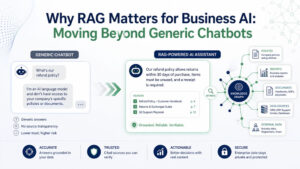
Agentic systems often need RAG because agents need reliable context. If an agent is acting on policy, customer data, business rules, or internal knowledge, it must retrieve trusted information. Without grounding, an agent may confidently act on incomplete or generic assumptions. That is dangerous. RAG helps agents access relevant documents, policies, SOPs, reports, and knowledge bases. Structured data access helps agents work with metrics and operational records. Together, they create a more reliable knowledge foundation. A simple rule is: do not give agents more autonomy than your knowledge foundation can support.
Human Oversight and Control
Agentic AI increases the importance of human oversight. Leaders should decide:
- What can the agent do independently?
- What requires human review?
- What actions are prohibited?
- What data can the agent access?
- What tools can it use?
- What should be logged?
- How are errors detected?
- Who is accountable for the output?
- How can a human stop or override the process?
Human-in-the-loop design is not a weakness. It is a responsible design.
For many business use cases, the best early agentic systems should assist, prepare, classify, draft, recommend, or route, while humans approve final action in high-risk contexts.
Agentic AI and Governance
Agentic AI requires stronger governance than basic AI tools because agents may affect workflows, records, customers, employees, or decisions. Governance areas include:
- permissions
- approved tools
- data access
- audit logs
- monitoring
- validation
- escalation
- risk tiering
- security
- compliance
- fallback procedures
Leaders should treat agentic workflows as operational systems, not casual experiments. A drafting assistant can be corrected by a user. An agent that updates records or routes customer cases can create operational consequences. That difference matters.
Where Organizations Should Start
Organizations should start with low-to-medium-risk workflows that are repetitive, time-consuming, and easy to monitor. Good starting points may include:
- internal knowledge Q&A
- meeting-to-action item workflows
- support ticket classification
- document summarization with human review
- sales research briefs
- HR onboarding checklists
- policy lookup assistants
- report preparation workflows
Avoid starting with high-stakes autonomous decision-making. Do not begin with legal decisions, medical advice, financial approvals, hiring decisions, or customer-impacting actions without strong controls. Start where AI can assist and humans can supervise.
A Practical Agentic AI Readiness Checklist
Before building or buying agentic AI, ask:
- Is the workflow clearly mapped?
- Is the business goal measurable?
- Are the required documents and data trustworthy?
- Are permissions and access rules clear?
- What tools will the agent use?
- What actions can it take?
- Where is human review required?
- How will errors be detected?
- What logs and monitoring are needed?
- Who owns the workflow?
- How will the pilot be evaluated?
If these questions cannot be answered, the organization may not be ready for agentic AI at scale.
Final Thought
Agentic AI is not just the next buzzword. It represents a real shift from AI as a response tool to AI as a workflow participant. But this shift requires maturity. Organizations need AI literacy, prompting skills, tool-fit understanding, trusted knowledge, workflow clarity, governance, and human oversight before giving AI more responsibility. Basic AI tools help people learn how to work with AI. Agentic AI asks organizations to redesign how work moves. That is why the journey matters. Start with practical AI skills. Build trust through grounded knowledge. Map workflows carefully. Add automation responsibly. Then explore agentic AI where it creates real value. Agentic AI is most powerful when it is not treated as magic. It is most valuable when it is designed as part of a responsible human-AI operating model.