

Many organizations want to scale AI quickly. They see competitors experimenting with generative AI. Employees are using ChatGPT or Copilot. Vendors promise productivity gains. Leaders hear about AI agents, knowledge assistants, and workflow automation. The pressure to act is real. But scaling AI before the organization is ready can create confusion, risk, and wasted investment.
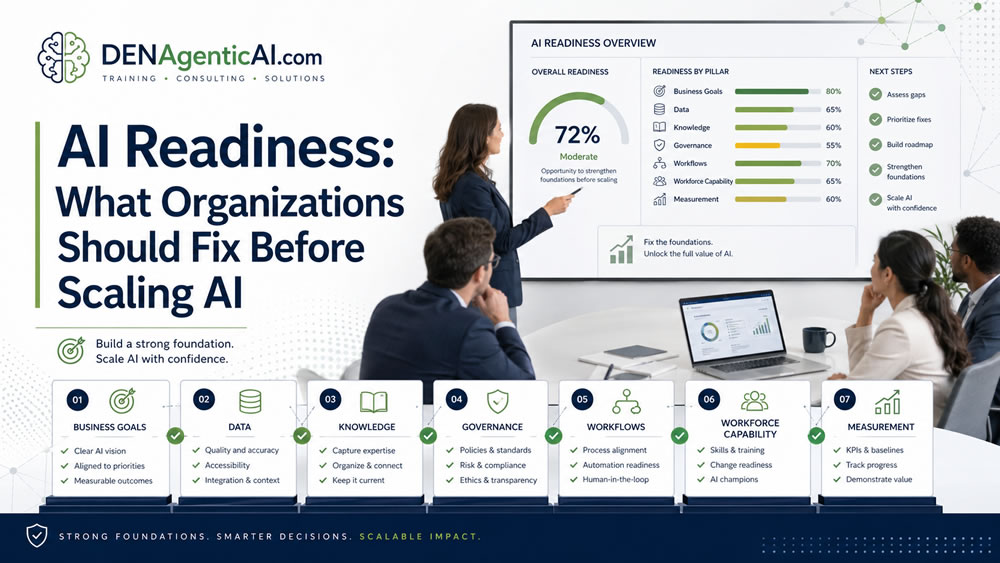
AI readiness is not only a technology issue. It is a business, data, knowledge, governance, workforce, and workflow issue. Before scaling AI, organizations need to fix the foundations that determine whether AI adoption produces value or simply accelerates existing problems. A useful starting point is this: AI does not magically solve organizational disorder. It often exposes it.
If data is fragmented, documents are outdated, permissions are unclear, processes are inconsistent, and employees are untrained, AI may amplify confusion. To scale AI responsibly, organizations need readiness across several areas.
1. Business Goal Readiness
The first readiness question is strategic: What business problem are we trying to solve?
Many AI initiatives begin with tool excitement rather than business clarity. A team wants a chatbot. Another wants Copilot. Another wants agents. But unless leaders define the work problem, it is hard to measure value. Organizations should identify priority goals such as:
- improving employee productivity
- reducing customer support backlog
- improving research and reporting speed
- increasing knowledge access
- reducing manual workflow steps
- improving decision support
- reducing operational errors
- supporting compliance or policy access
A clear business goal helps determine whether the right solution is training, a productivity tool, a knowledge assistant, automation, analytics, or an agentic workflow. Readiness question: Which measurable work problem should AI help improve first?
2. Data Readiness
AI systems often depend on data. For analytics, forecasting, reporting, personalization, and decision support, data quality matters. If the data is incomplete, inconsistent, duplicated, outdated, or poorly governed, AI outputs become unreliable. Organizations should review:
- where important data lives
- whether data definitions are consistent
- who owns key datasets
- whether data quality is monitored
- whether business metrics are clearly defined
- whether data access is governed
- whether reporting logic is trusted
For example, if different departments define “active customer” differently, an AI system may produce inconsistent answers. If sales data and finance data do not reconcile, AI-generated insights may create disputes rather than clarity.
Readiness question: Do we have trusted data and agreed definitions for the decisions AI will support?
3. Knowledge Readiness
Many generative AI use cases depend on documents and internal knowledge: policies, procedures, reports, manuals, contracts, training materials, FAQs, project notes, and strategic documents. This is where many organizations struggle. Their knowledge is often spread across shared drives, email attachments, outdated PDFs, personal folders, intranet pages, and collaboration tools. There may be duplicate versions, conflicting guidance, unclear owners, and outdated documents. If an organization wants a knowledge assistant or RAG system, it must first ask whether its knowledge is ready for AI. Knowledge readiness includes:
- document ownership
- version control
- approval status
- source quality
- metadata
- access permissions
- update frequency
- conflict resolution
- classification of sensitive documents
AI can retrieve and summarize documents, but it cannot determine organizational truth if the source environment is chaotic.
Readiness question: Which documents are authoritative, current, and safe for AI to use?
4. Tool and Technology Readiness
Organizations need to understand their current technology environment before scaling AI. AI tools may need access to documents, emails, data platforms, workflow systems, identity management, security controls, APIs, and collaboration platforms. Technology readiness includes:
- approved AI tools
- identity and access management
- data storage and integration
- secure document repositories
- workflow platforms
- logging and monitoring
- API access
- security review
- vendor risk assessment
Leaders should not treat AI adoption as a standalone software purchase. AI often connects to the work environment. That means architecture matters.
Readiness question: Can our technology environment support AI safely and effectively?
5. Workflow Readiness
AI creates the most value when connected to real workflows. But many organizations do not have a clear map of how work actually moves. Before automating or adding AI agents, organizations should understand:
- what triggers the workflow
- what inputs are required
- who performs each step
- where delays occur
- what decisions are made
- what exceptions happen
- what systems are updated
- where human review is required
- what output is expected
Without workflow clarity, automation can create new problems. A poorly understood process should not be automated blindly. AI may make the process faster, but not necessarily better.
Readiness question: Do we understand the workflow well enough to improve it with AI?
6. Governance Readiness
AI readiness requires governance. This does not mean slowing everything down with bureaucracy. It means creating practical guardrails so people know what is allowed, what needs review, and what should not be done. Governance readiness includes:
- acceptable use policy
- data privacy rules
- approved tools list
- sensitive data guidance
- human review requirements
- risk tiering of use cases
- escalation process
- audit and monitoring requirements
- accountability for AI-assisted outputs
For example, AI use in brainstorming or drafting low-risk internal content may need light guidance. AI use in legal, financial, HR, medical, compliance, or customer-facing decisions requires stronger controls.
Readiness question: Do employees know how to use AI safely, and do leaders know how to govern higher-risk use cases?
7. Workforce Readiness
AI adoption depends on people. Tools do not create value if users do not understand how to use them. Employees need training, confidence, and judgment. Workforce readiness includes:
- basic AI literacy
- prompting skills
- tool-fit understanding
- privacy awareness
- output evaluation skills
- role-specific use cases
- manager guidance
- change communication
- internal champions
- psychological safety around AI adoption
Many organizations underestimate training. They buy tools but do not teach employees how to use AI effectively. This leads to weak adoption, misuse, or disappointment.
Readiness question: Are our people trained to use AI responsibly and productively?
8. Measurement Readiness
AI initiatives should be evaluated. Without metrics, organizations cannot know whether AI is creating value. Possible measures include:
- time saved
- cycle time reduction
- quality improvement
- error reduction
- customer response time
- employee satisfaction
- adoption rate
- cost reduction
- improved decision speed
- reduced backlog
- better knowledge access
Not every AI use case needs a complex ROI model, but every pilot should define what success means.
Readiness question: How will we know whether this AI initiative worked?
Common Failure Patterns
Organizations often struggle with AI because they skip readiness work. Common failure patterns include:
- buying tools before defining use cases
- launching pilots without success metrics
- allowing employees to use tools without privacy guidance
- building knowledge assistants on messy documents
- automating workflows that are not well understood
- treating AI output as trustworthy without verification
- underinvesting in training
- failing to assign ownership
These problems are avoidable.
A Practical AI Readiness Checklist
Before scaling AI, organizations should ask:
- What business goal are we pursuing?
- What work tasks or workflows are involved?
- What data is required?
- What documents or knowledge sources are required?
- Who owns the data and knowledge?
- What tools are approved?
- What risks are present?
- What human review is needed?
- What policies apply?
- What training do employees need?
- What metric will show success?
This checklist turns AI adoption from excitement into disciplined execution.
Final Thought
AI readiness is the difference between experimenting with AI and scaling AI responsibly. Organizations should not wait forever. But they should not scale blindly. The goal is to move with urgency and discipline. Fix the foundations first: business goals, data, knowledge, workflows, governance, workforce capability, and measurement. Then AI can become more than a tool. It can become a practical capability for better work, better decisions, and digital transformation.

