

AI Governance Self-Assessment

Is Your AI Use
Properly Governed?

Ten questions across six governance elements — know exactly where your AI governance gaps are, your governance tier, and what to fix first.

10
Questions
4 min
To complete
Free
Instant result
Policy & Tools Risk Tiering Human Oversight Data Privacy Shadow AI Training & Auditability
1
2
3
4
5
6
7
8
9
10
📋
Policy & Approved Tools
2 questions · up to 2 points
1
Written AI Use Policy
Does your organisation have a written AI use policy that covers approved tools, prohibited uses, and data handling rules — accessible to all employees?
2
Approved Tools Register
Is there a named list of approved AI tools and a defined process for requesting new ones?
Risk Tiering
1 question · up to 1 point
3
Risk Classification Practice
Do you classify AI use cases by risk level — low, medium, high — and apply different oversight requirements based on that classification?
👁
Human Oversight
1 question · up to 1 point
4
Defined Human Review Step
For AI outputs that affect clients, financial decisions, compliance, or HR — is there a defined human review step before those outputs are acted on?
🔒
Data Privacy & Incident Response
2 questions · up to 2 points
5
Data Input Privacy Rules
Are there clear rules about what internal data employees may and may not input into AI tools — including client data, PII, and confidential business information?
6
Incident Escalation Path
If an AI system produced a wrong or harmful output, does your organisation have a defined escalation path — including who is responsible and how the situation is contained?
🕵
Shadow AI & Governance Ownership
2 questions · up to 2 points
7
Shadow AI Presence Inverted scoring
Are you aware of AI tools being used in your organisation that have not been reviewed or approved by anyone in a governance capacity?
8
Named Governance Owner
Is there a specific named person or team accountable for AI governance decisions — policy maintenance, tool approvals, and incident response?
📚
Training & Auditability
2 questions · up to 2 points
9
Training-Gated Tool Access
Is AI tool access tied to minimum training completion — or can employees access approved AI tools without completing any training first?
10
Audit Trail & Reconstructability
If a regulator, auditor, or client asked how a specific AI-assisted decision was made — could your organisation reconstruct the process and evidence?

What Your Score Tells You

1
Governance tier
Governed, Partially Governed, or Ungoverned — with a score out of 10 across six elements.
2
Most urgent gap identified
The specific governance element creating the most active risk — with a concrete action to address it first.
3
Live risk signal
If your score indicates ungoverned AI use, you receive an honest assessment of the current exposure and the fastest path to resolution.

A minimum viable AI governance framework can be built in two to three weeks. The consultation identifies exactly what to build first.

LATEST Posts

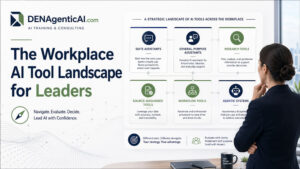
The-Workplace-AI-Tool-Landscape-for-Leaders

The Workplace AI Tool Landscape for Leaders

Leaders today are surrounded by AI requests. One department wants a writing assistant. Another wants AI inside email and meetings …
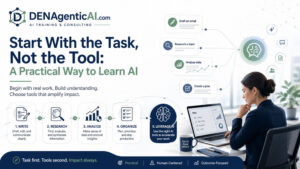
Start With the Task, Not the Tool

Start With the Task, Not the Tool: A Practical Way to Learn AI

Many people begin their AI learning journey by asking the same question: “Which AI tool should I use?” It is …
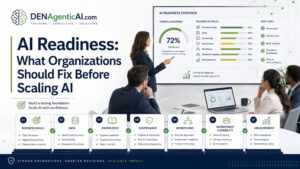
AI Readiness- What Organizations Should Fix Before Scaling AI

AI Readiness: What Organizations Should Fix Before Scaling AI

Many organizations want to scale AI quickly. They see competitors experimenting with generative AI. Employees are using ChatGPT or Copilot …
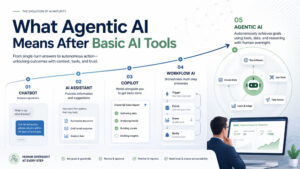
What Agentic AI Means After Basic AI Tools

What Agentic AI Means After Basic AI Tools

Many people first experience AI through chat. They ask a question, receive an answer, refine the prompt, and use the …
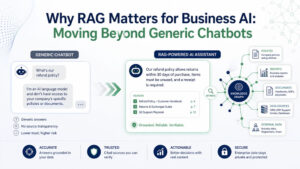
Why RAG Matters for Business AI

Why RAG Matters for Business AI: Moving Beyond Generic Chatbots

Many organizations begin their AI journey with generic chatbots. Employees ask questions, draft content, summarize ideas, and explore possibilities. This …