
Agentic Knowledge Engine Platform

A governed, multi-agent knowledge platform that turns your data, documents, policies, and workflows into a secure intelligence layer. Give your teams trusted answers, grounded analysis, and a stronger foundation for future AI automation.

What is the Agentic Knowledge Engine Platform?

The Agentic Knowledge Engine Platform is a private, governed intelligence layer built to help organizations retrieve, connect, validate, and use business knowledge more effectively.

It sits across your structured data, unstructured documents, internal policies, operating procedures, and business workflows, turning fragmented information into one queryable and explainable system. Instead of relying on a generic AI model to guess, the platform retrieves approved context, reasons across relevant sources, and returns grounded responses that users can trust.

The result is not just faster access to information. It is a more durable foundation for decision support, operational intelligence, internal knowledge access, and future digital teammates.

ai strategy

Problems the Agentic Knowledge Engine Solves

Most organizations are approaching AI from the wrong starting point. They try to automate actions before the system can safely understand business context, access trusted knowledge, and reason across internal sources. The Agentic Knowledge Engine Platform helps solve that problem by addressing the gaps that hold AI adoption back:

Business knowledge is fragmented: Critical information is spread across databases, documents, spreadsheets, shared drives, dashboards, SOPs, and human memory.

Generic AI lacks company context: Out-of-the-box models do not understand your internal definitions, policies, customer history, contracts, workflows, or reporting logic.

Trust in AI outputs is low: If leaders and teams cannot verify where an answer came from, they will not rely on it for meaningful work.

Workflow automation is being attempted too early: Automation without grounding increases the risk of inaccurate outputs, weak decisions, and operational mistakes.

AI readiness is limited by poor knowledge architecture: Without a governed retrieval and memory layer, AI remains inconsistent, hard to scale, and difficult to control.

How the Agentic Knowledge Engine Works

The platform follows a practical lifecycle that helps AI move from raw access to trusted business capability.

1

Connect Your Knowledge Sources

The platform connects to your structured and unstructured sources, including data warehouses, documents, SOPs, spreadsheets, dashboards, CRM and ERP systems, support records, and other approved business systems.

2

Organize Business Context

It structures the entities, relationships, metrics, rules, and knowledge objects that give your business its operating context. This helps the system understand not only content, but also how that content connects across teams, processes, and decisions.

3

Orchestrate Specialist Agents

A supervisory intelligence layer routes each request through the right combination of specialist agents for analytics, document retrieval, reasoning, monitoring, and scenario support. Instead of one model trying to do everything, the platform coordinates domain-aware work across tasks.

4

Validate Before Presenting

Responses are checked against governance rules, source provenance, access controls, and validation logic so outputs are more explainable, traceable, and operationally safe.

5

Learn Through Governed Improvement

The platform captures useful feedback, recurring patterns, and validated workflows over time so it can improve relevance and continuity without losing human oversight or control.

Five Core Capabilities of the Platform

The Agentic Knowledge Engine is not a single AI tool. It is a coordinated platform made up of five core capabilities that work together.

1

Supervisor Orchestration

A supervisory layer interprets the request, routes work to the right specialist agents, evaluates outputs, and determines whether the answer is complete and grounded before returning it to the user.

2

Unified Knowledge Fabric

The platform brings structured data, documents, policies, and workflow context into one connected retrieval architecture so users can get answers across silos instead of searching source by source.

3

Organizational Memory

It preserves approved context, learned procedures, recurring investigation paths, and business rules so the system becomes more useful over time without forcing users to repeat the same context.

4

Trust, Validation, and Governance

The platform applies citations, validation checks, role-based controls, and provenance tracking so responses are easier to verify, govern, and trust.

5

Governed Evolution

It improves through controlled feedback loops, promotion review, and human oversight so the system can evolve safely instead of changing silently in production.

A Better Starting Point for AI

Before businesses deploy autonomous or semi-autonomous AI workers, they need the engine that organizes, governs, retrieves, validates, and remembers business knowledge. That is what this platform is built to provide.

If your organization wants to move beyond isolated AI experiments and build a trusted foundation for knowledge access, decision support, and future workflow agents, the next step is a focused platform discussion.

LATEST Posts

The-Workplace-AI-Tool-Landscape-for-Leaders

The Workplace AI Tool Landscape for Leaders

Leaders today are surrounded by AI requests. One department wants a writing assistant. Another wants AI inside email and meetings …
Start With the Task, Not the Tool

Start With the Task, Not the Tool: A Practical Way to Learn AI

Many people begin their AI learning journey by asking the same question: “Which AI tool should I use?” It is …
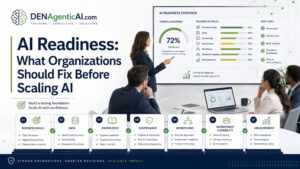
AI Readiness- What Organizations Should Fix Before Scaling AI

AI Readiness: What Organizations Should Fix Before Scaling AI

Many organizations want to scale AI quickly. They see competitors experimenting with generative AI. Employees are using ChatGPT or Copilot …
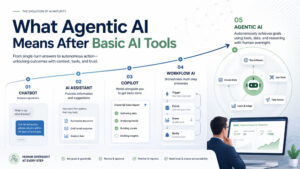
What Agentic AI Means After Basic AI Tools

What Agentic AI Means After Basic AI Tools

Many people first experience AI through chat. They ask a question, receive an answer, refine the prompt, and use the …
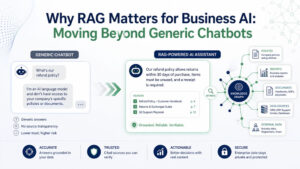
Why RAG Matters for Business AI

Why RAG Matters for Business AI: Moving Beyond Generic Chatbots

Many organizations begin their AI journey with generic chatbots. Employees ask questions, draft content, summarize ideas, and explore possibilities. This …

AI Decision-Making

The Four Levels of AI Decision-Making: From Assistance to Autonomy

As businesses across industries strive to stay competitive and efficient, artificial intelligence (AI) is increasingly being adopted to streamline decision-making …